
 Image 1 of 1
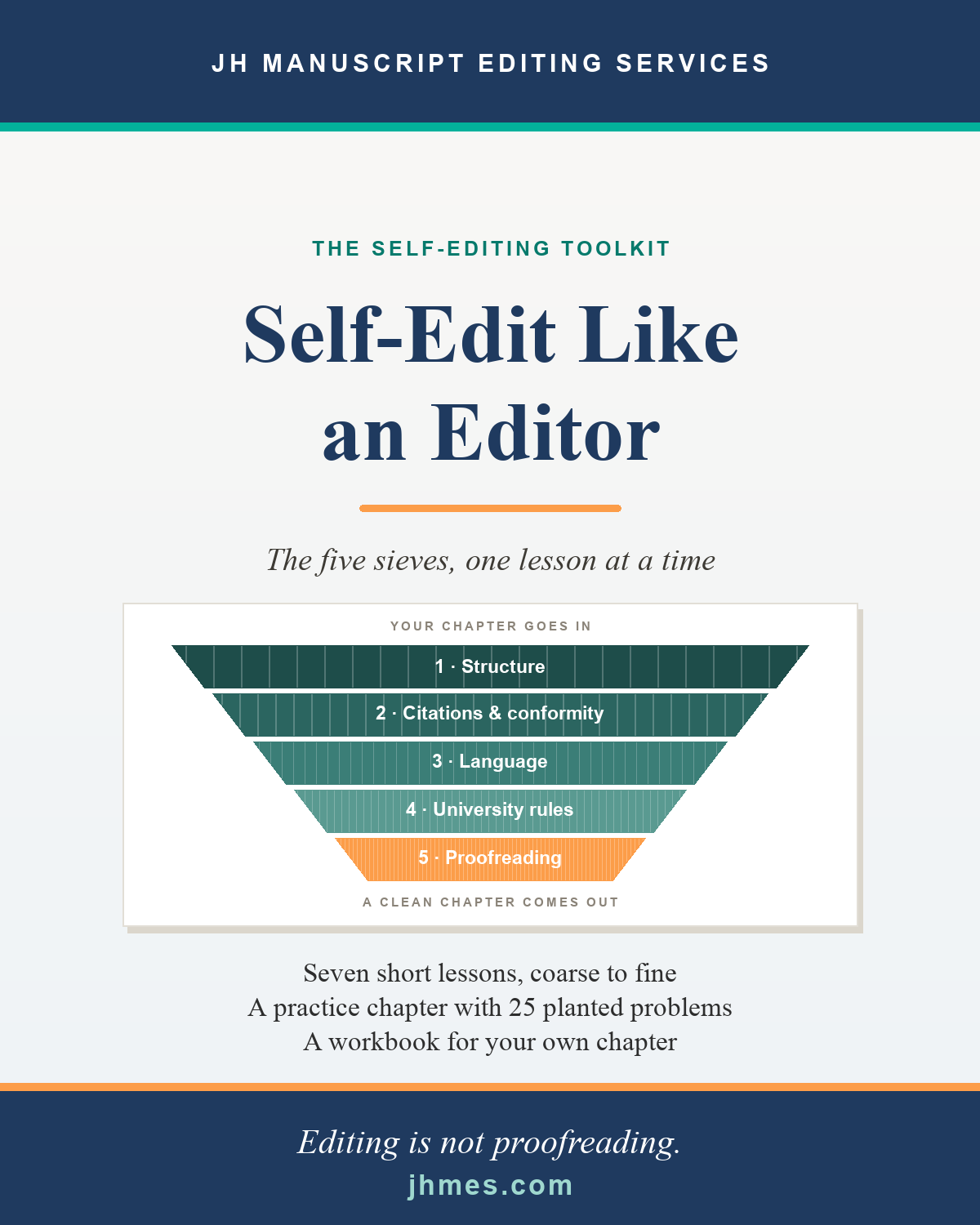
When I edit a dissertation, I don't read it once from the top. I run it through five passes, each with a finer mesh than the last: structure, then citations, then language, then the university's style rules, and a proofread to finish. I call them the five sieves.
This toolkit teaches you to run those five sieves on your own chapter. It's a short, self-paced course. Read a lesson, practice on a made-up chapter with problems planted in it, check yourself against the answer key, then run the same sieve on your own work.
WHAT'S INSIDE
Self-Edit Like an Editor (PDF guide, 14 pages) — seven short lessons: why editing isn't proofreading, how to set up your file, one lesson for each sieve with before-and-after examples, and a last lesson on what self-editing can't do and when a second reader helps
The practice chapter (Word) — a made-up findings chapter with 25 problems planted in it, five for each sieve, and a sample program checklist
The answer key (PDF) — where each problem is, what's wrong, and what to do about it
The Five Sieves workbook (Word) — a page for each sieve to run on your own chapter, with checks to tick and room for what you find, plus a style sheet and the searches to run in Word
An honest note: no writer can fully edit their own work. When you reread your own sentences, your mind supplies what you meant to say. The sieves narrow that gap by giving your eye one job at a time, and they'll take your chapter much further than another read-through. They don't check your argument; that's for you and your committee.
PAIR IT WITH
The Complete Dissertation Toolkit ($49) — nine kits in one download, including the APA 7 template, the Tables & Figures Kit, and the Front Matter Kit that make Sieve 1 easier
Managing Your Dissertation References ($12) — the reference audit that takes Sieve 2 further
START FREE
How Editing Works — watch the five sieves catch the problems in one paragraph, with five short interactive demos
WANT A SECOND READER?
Dissertation editing — I run the same five sieves across your whole dissertation, so nothing hides between chapters